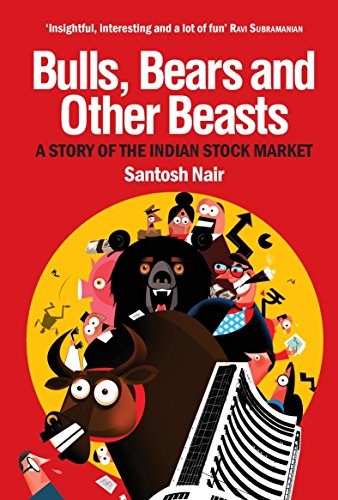
Santosh Nair is Editor at moneycontrol.com. He has been Markets Editor at The Economic Times and has reported for Business Standard. He has also worked at myiris.com and CRISIL Market Wire. Santosh Nair’s book Bulls, Bears and Other Beasts tells the story of the Indian stock market. Lalchand Gupta (fictional character) takes you on an exciting journey through Dalal Street in this brief history of the Indian stock market post liberalization.
Lala joined the brokerage firm in the year 1998 as a backoffice employee. UTI was the biggest dealer at that time. The brokerage was as high as 1.5% which is justified due to physical shares. Front running was taking place as UTI or promoters of company place huge order before that they were placing their own order to get profit from falling or rise of the price(short-selling).
Mistakes in the deal are recognized through Sauda pads if deals don’t match then exchange call both parties and settled the trade. After trading hours there operated an unofficial market for some of the more liquid stocks. This was called the kerb market.
With the entry of the National Stock Exchange (NSE) and the introduction of screen-based trading in 1994, this practice ended, as clients could verify what prices their shares were traded for. The book also tell us the Harshad Mehta scam of the early 90’s, Ketan Parikh’s rigging operations in 1999-2000, the IPO rigging scandal of 2010, and NSEL’s commodities trading fraud in 2012.
Harshad’s scale of activity had increased and the big moves in stocks like ACC, Apollo Tyres, Gujarat Ambuja, Tata Tea and SPIC were being attributed entirely to him.The stock of ACC went from 200 Rs to 9000 Rs. Harshad Mehta exploited the loopholes in inter-bank transactions by using bank receipts (BRs) to fund his stock operation.His scam was exposed in 1992.After that government decide to introduce SEBI(Securities & Exchange Board Of India) to regulate stock market operations
Market capitalization is the share price multiplied by the outstanding number of shares (equity base) of a company. The higher their market capitalization (or valuation of the company), the easier it became for companies to raise more funds by selling the least number of shares. the upcoming IPO of Reliance Power, the largest ever IPO in the history of the Indian stock market. The issue size was around Rs 11,500 crore.
Another notable incident in October was the near run on ICICI Bank, which became the center of nasty rumors following the demise of Lehman Brothers. The stock tanked from Rs 450 to Rs 305 in three trading sessions on market chatter that its foreign subsidiaries had suffered massive losses as a result of a sizeable exposure to securities issued by Lehman Brothers.
When the market is on rise some politicans and their affilates had given huge sum of money to Ketan Parekh to grow it. The Union Budget in February 2001 brought brief cheer to the market.LTCG was abolished and STT was introduced. The ceiling on FII investment in a company was now raised to 49 per cent.
On 7 January 2009, B. Ramalinga Raju, founder of Satyam Computer Services, wrote to SEBI and the stock exchanges confessing that he had been cooking the company’s books for the last few years by showing non-existent revenues and bank balances. Raju’s admission sent the Satyam stock crashing by 83 per cent, to Rs 30, from the previous day’s closing price of Rs 179.
After the NSEL and MCX scam the Ministry of Consumer Affairs ordered NSEL to stop issuing fresh contracts.
 Investors Mindset