P/E Ratio=Current Market Price / Earnings per share
The Price-Earning ratio denotes the value of the company at the current market rate. It also denotes that how many years will it take for company to pay back the the amount we paid for each share.
Example: Suppose Company A has EPS of 5 Rs and its CMP is 50 Rs / Share. So its P/E ratio will be 50/5=10.
P/E ratio also affects your payback period. P/E ratio is meaningless without growth rate.
PEG Ratio= P/E Ratio / Growth Rate
PEG ratio can be found by dividing the company’s P/E ratio by its growth rate.
Example: Suppose Company A has P/E ratio of 20 and its growth rate is 5% then its PEG ratio will be 20/5=4.
Let’s take some more example to understand this.

Company A is providing return of 3% every year at the P/E ratio of 8 which is good but still I have to wait for 11 years to receive my money which I have paid for each share.

Company B is providing return of 10% every year at the P/E ratio of 18 which means I have to wait for 6 years to receive my money which I have paid for each share.

Company C is providing return of 6% every year at the P/E ratio of 22 which is very high according to its P/E and I have to wait for 15 years to receive my money which I have paid for each share.
The payback period is longest in Company C and shorter period is in Company B which is better for me as it is providing return of 10% every year.
Now Lets take a look at PEG ratio of these company.
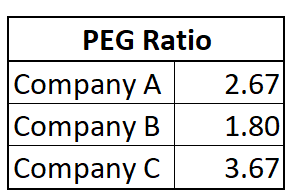
The Company with low PEG ratio will payback your money earlier than the company with high PEG ratio.
 Investors Mindset